

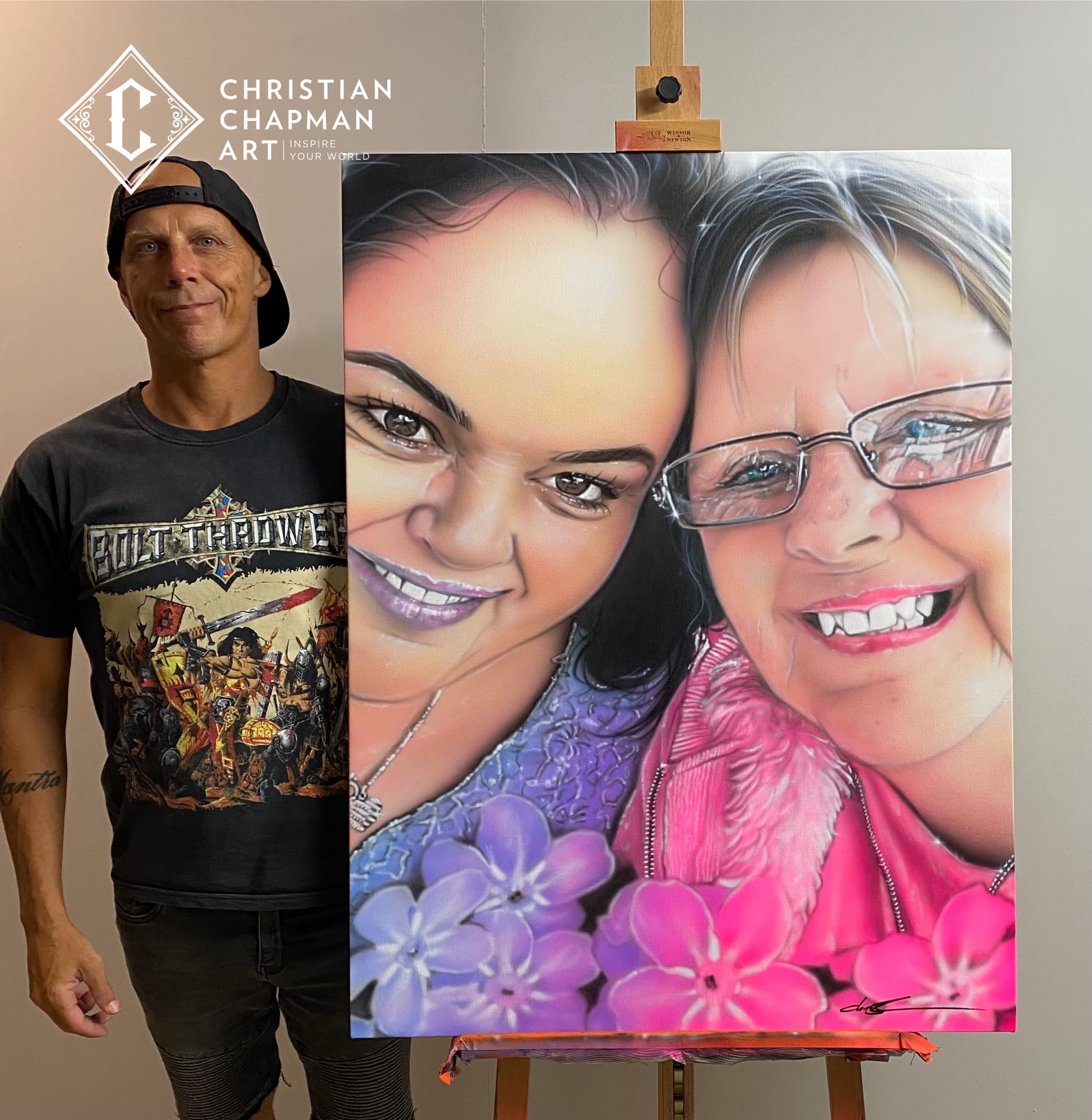
Why Commissioned Portraits Matter
Learn more about our beautiful original portraits HERE.
A photo can sit forgotten in a mobile gallery for years. A painting on the wall does not let that happen. Commissioned portraits bring a person, pet or icon into your space with presence - not just as an image, but as something felt every time you walk past it.
That difference is why people keep coming back to portrait art when the subject truly matters. It might be a child at a fleeting age, a beloved dog with unmistakable character, a musician who shaped your life, or a family member you want to honour properly. The best portrait commissions do more than resemble the subject. They hold onto expression, atmosphere and identity with enough strength to stop you in your tracks.
What makes commissioned portraits feel so powerful
Not all personalised art leaves a lasting impact. Some pieces are pleasant enough, but they never move beyond decoration. The portraits people treasure for decades tend to share two qualities: true likeness and emotional weight.
Likeness is the obvious part, but it is also where many artworks rise or fall. If the eyes are slightly off, if the posture feels generic, or if the personality has been flattened into a polished but empty version, the result can feel disappointing no matter how technically skilled it appears. A serious portrait artist understands that realism is not simply about copying a reference photo. It is about recognising what makes that face, that gaze, that presence unmistakably theirs.
Emotional weight is harder to define, but people know it when they see it. It is the difference between a painting that says, yes, this is them, and one that says, this is exactly why they matter. That might come through intensity, tenderness, stillness or attitude. A strong commission captures more than anatomy. It captures significance.
Commissioned portraits as memory, tribute and statement
People commission portraits for deeply personal reasons, but those reasons often sit in three broad spaces: memory, tribute and statement. Sometimes all three overlap.
For families, portraiture can preserve a moment that passes too quickly. Children grow, features change, and even the small details you think you will always remember can soften over time. A portrait fixes those details with care and permanence. It creates something more enduring than a phone image because it has been deliberately made, not casually taken.
For pet owners, the emotional pull is just as strong, and often stronger than expected. Animals have distinct personalities, habits and expressions that become part of daily life. A well-made portrait can honour that bond in a way that feels affectionate without becoming sentimental fluff. It gives proper visual respect to a companion who shaped the rhythm of a home.
Then there are tribute pieces. Memorial portraits, portraits of parents or grandparents, or artworks honouring someone whose absence is still felt can carry enormous emotional importance. In these cases, realism matters even more. You are not after a loose impression. You want recognition, dignity and presence.
There is also a different kind of commission - one driven by passion and identity. Music lovers, film fans, collectors and homeowners often commission portraits of public figures because those faces mean something specific to them. A musician might represent youth, rebellion, comfort, grief, ambition or a whole chapter of life. In the right hands, that portrait becomes more than fandom. It becomes a statement piece with personal history behind it.
Why realism changes the result
Stylised portraiture has its place, but when the goal is emotional impact, realism often carries the greatest force. It leaves less room for approximation. It asks the artist to meet the subject with precision and confidence.
That does not mean every realistic portrait feels alive. Technical detail alone can produce a cold result. The strongest artists balance accuracy with intensity. Skin tone, structure, light and texture all matter, but so does judgement. Which expression says the most? Which crop has the strongest presence on a wall? Should the mood feel intimate, dramatic or bold enough to anchor an entire room?
These are artistic decisions, not just production choices. They affect whether a portrait blends into the background or becomes the first thing people notice when they enter the space.
This is one reason commissioned portraits often work so well as centrepiece art. Unlike generic wall décor, they already carry meaning before they are even hung. If they are executed with strength, they also bring scale, atmosphere and personality into a room. That is especially powerful in homes where art is expected to do more than fill empty wall space.
Choosing the right subject for a portrait commission
The right subject is not always the most obvious one. Some clients assume a commission has to be formal, highly traditional or tied to a milestone. It does not.
A compelling portrait can come from many directions. A child covered in personality. A black-and-white study of a parent. A dog with striking markings and an even stronger stare. A larger-than-life musician portrait for a media room. A celebrity piece that reflects taste, nostalgia and confidence. The real question is not whether the subject is worthy enough. It is whether the subject means enough to deserve permanent space in your home.
That is where personal taste matters. Some buyers want softness and warmth. Others want edge, drama and visual punch. There is no single correct approach, but there is a correct match between the artwork and the reason behind it. A memorial piece needs sensitivity. A rock icon portrait may need attitude and scale. A family commission should still feel elevated, not overly sweet or generic.
The trade-off between speed, price and quality
Portrait commissions are personal, so buyers often feel pressure to get every decision perfect. That is understandable, but one of the most useful things to know is this: quality commissioned portraits take time, and that time is part of the value.
Fast-turnaround art can be tempting, especially when buying for a birthday, anniversary or holiday. But speed usually asks for compromise somewhere, whether in detail, refinement or the depth of the artist's engagement with the subject. The same applies to bargain pricing. A cheap commission may still look decent online, yet feel flat or underwhelming in person.
Premium does not have to mean inaccessible, but it should mean intentional. You are paying for observation, technical control, artistic judgement and a finished piece that holds its own on a wall for years. That is a very different proposition from ordering something decorative and disposable.
For buyers who care about both craftsmanship and emotional value, it makes sense to think of a portrait commission as a long-term acquisition rather than an impulse purchase. The best pieces keep giving back. They become part of the home, part of family memory and often part of what visitors remember most.
What to look for before commissioning portraits
Before moving ahead with an artist, look closely at consistency. One strong sample is not enough. You want to see repeated evidence of accurate likeness, confident detail and emotional presence across different subjects. An artist who can handle children, pets, musicians and memorial work with equal authority is showing range, not just style.
It is also worth paying attention to how the finished work feels in interiors. Portraits are not viewed only up close. They are lived with. A successful commission should look impressive from across the room and rewarding at close range. That balance matters more than buyers sometimes expect.
Communication matters too, although not in the sense of endless revisions and uncertainty. The process should feel clear and professional. You should know what kind of reference material produces the best result, what size suits your space, and what mood or impact the piece is meant to deliver. Confidence in the process usually reflects confidence in the work.
For collectors and homeowners who want realism with presence, that combination is exactly why artists such as Christian Chapman stand out. The goal is not simply to make art from a photo. It is to create a portrait with enough strength, accuracy and feeling to earn its place on the wall.
Why commissioned portraits outlast trends
Interior trends change. Colour palettes shift. Print styles come and go. But artwork tied to identity, memory and admiration rarely loses relevance in the same way. That is the quiet strength of portraiture. When the subject means something real, the work continues to matter long after fashion has moved on.
That staying power is especially important if you are buying art for a forever home, a meaningful gift or a collection with personal taste at its centre. Commissioned portraits are not filler pieces. At their best, they become anchors - visually striking, emotionally charged and impossible to replace with something off the shelf.
If a person, pet or icon has shaped your life enough to deserve more than another image on a screen, a portrait gives that feeling the scale and permanence it deserves.